Red Light Dose Calculator
Use this calculator to work out the correct distance, time, power, and dosage that's right for you.
Dosage Calculator
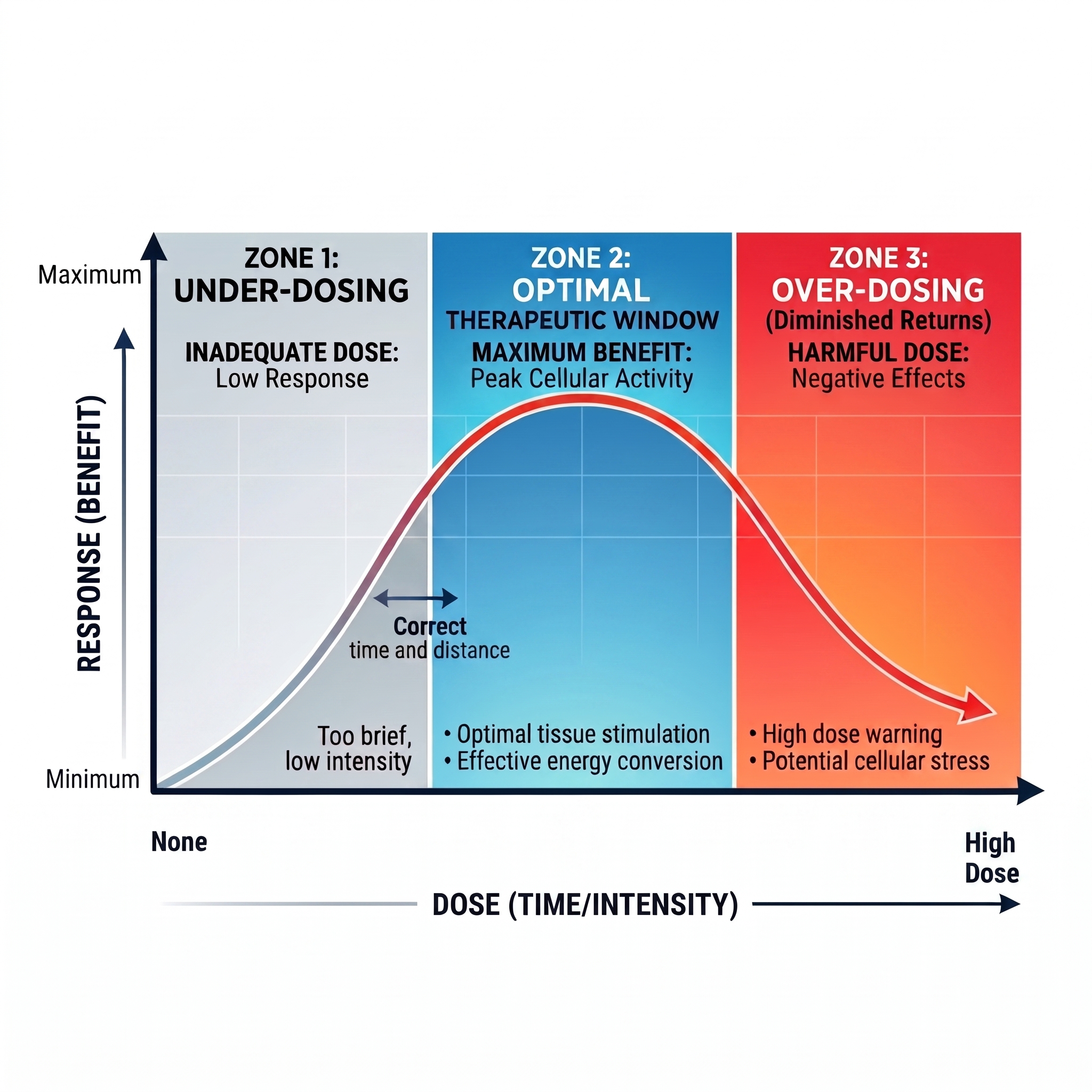
The biphasic dose-response - often linked to the Arndt-Schulz law - is a fundamental principle in light therapy stating that biological tissue responds differently depending on the total amount of light energy absorbed. Moderate doses of red and near-infrared light stimulate cellular activity, whereas excessively high doses can inhibit repair or trigger cellular stress. As detailed in the PubMed review on Biphasic Dose Response in Low Level Light Therapy, light therapy does not follow a linear path where "more is always better" - instead, benefits follow a bell-shaped curve.
This response is divided into three distinct zones:
- Zone 1: Under-Dosing (Sub-Optimal): When the light intensity is too faint or the session is too short, photons do not deliver enough energy to activate cellular mitochondria, leading to minimal physiological effect.
- Zone 2: Optimal Window (Peak Stimulation): At the right dose, light stimulates cytochrome c oxidase within cells. This boosts ATP (cellular energy) production, improves local blood flow, and supports natural tissue repair without overloading the cell.
- Zone 3: Over-Dosing (Inhibition): Exceeding the target time or sitting too close to high-power panels can saturate cells and create excessive reactive oxygen species (ROS), causing diminishing returns or temporary fatigue.
Finding your ideal treatment window ensures safe, repeatable results without over-stimulating your cells. To learn more about identifying your ideal session times, read the article on Can You Overdo Light Therapy? or calculate specific times for your distance using the Kivo Red Light Therapy Dosage Calculator. For additional medical research on cellular signaling and dosing parameters, explore the updated study on PubMed's Dose-Response Archive.